

Medically Reviewed
Last updated: 24/04/2026
Refractive surgery is used to correct refractive errors such as nearsightedness (myopia), farsightedness (hyperopia), astigmatism, or presbyopia. Some procedures work by reshaping the cornea, while others involve implanting a lens inside the eye. In all cases, the goal is the same: to change how light is focused on the retina by altering the shape of the eye.
The most frequently performed refractive surgery is LASIK. Other commonly performed procedures include PRK and SMILE, along with several additional options. There is no single best procedure for correcting refractive errors. Patients should consult their ophthalmologist after a full eye exam to determine the most suitable option, taking into account their lifestyle and vision needs. In some cases, continuing to use glasses or contact lenses may be the best choice.
Who is a Good Candidate for Refractive Surgery?
Not every patient is an ideal candidate for refractive surgery. Eligibility generally requires:
- Being at least 21 years old for stable vision
- Having a stable eyeglasses prescription for at least 1 year
- Having a healthy cornea with adequate thickness
- Not having serious eye conditions such as keratoconus, glaucoma, or advanced dry eye disease
- Not being pregnant or breastfeeding, due to hormonal effects on vision
- Having realistic expectations about surgical outcomes
Patients who meet these requirements and want clearer vision without glasses may consider refractive surgery as an option.
Types of Refractive Eye Surgery
Refractive surgery includes multiple techniques designed for different vision correction needs. The main procedures include:
LASIK Surgery
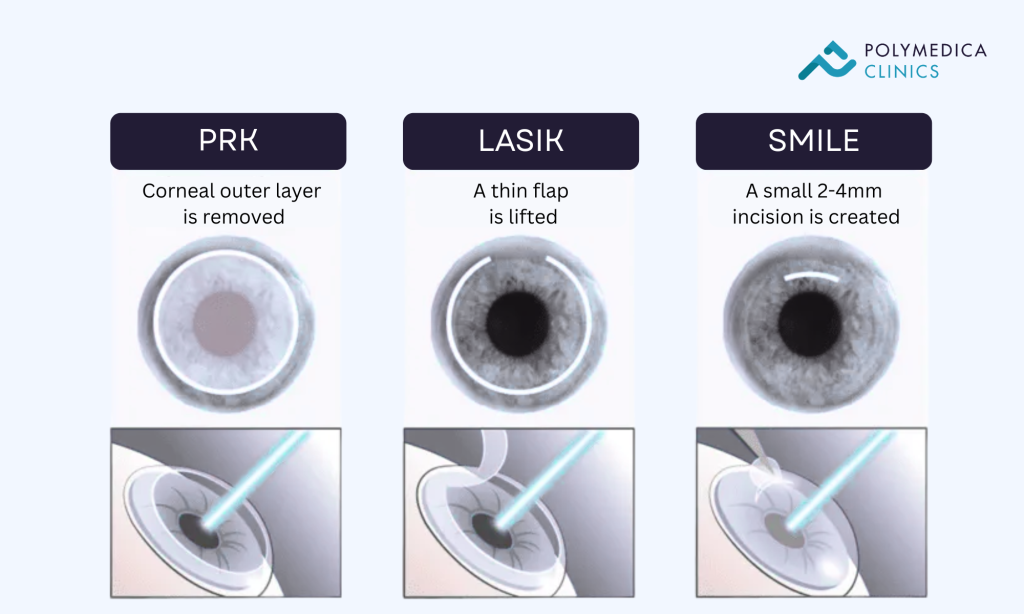
LASIK (Laser-Assisted In Situ Keratomileusis) is the most widely used refractive procedure. It involves creating and lifting a thin corneal flap using a microkeratome or femtosecond laser (femtoLASIK), reshaping the underlying corneal tissue with an excimer laser, and then repositioning the flap. Its benefits include rapid recovery with minimal discomfort, quick visual improvement, and a high long-term success rate.
PRK (Photorefractive Keratectomy)
PRK is among the earliest refractive eye surgeries. It involves removing the cornea’s outer layer (epithelium) and reshaping the underlying tissue with an excimer laser. Its advantages include suitability for patients with thinner corneas and no risk of flap-related complications, making it safer for people with active lifestyles. Although recovery takes longer than LASIK, PRK remains an effective option.
Refractive Lenticule Extraction – ReLEx SMILE / FLEX
SMILE (Small Incision Lenticule Extraction) and FLEX (Femtosecond Lenticule Extraction) are minimally invasive laser techniques in which a small lenticule (lens-shaped tissue) is removed from the cornea. Their benefits include the absence of a flap, lowering the risk of flap-related complications, faster healing, reduced risk of dry eye, and suitability for higher levels of nearsightedness. SMILE is especially useful for patients seeking a flapless procedure with quicker recovery and less postoperative discomfort.
Benefits & Risks of Refractive Surgery
Benefits
- Permanent vision correction
- Improved quality of life with less reliance on glasses or contact lenses
- High success rates and fast recovery
- Options tailored to different eye conditions
Risks
- Temporary discomfort and dry eyes after surgery
- Possible glare, halos, or night vision issues
- Rare complications such as undercorrection, overcorrection, or flap-related problems after LASIK
Alternative Refractive Surgery Procedures
Phakic Intraocular Lenses (IOLs)
Phakic IOLs are designed for individuals with very high refractive errors that cannot be safely corrected with corneal surgery. Also called implantable contact lenses (ICL), these lenses are surgically placed inside the eye in front of the natural lens, which remains intact, preserving its focusing ability.
During implantation, the ophthalmologist positions the lens either in front of or behind the iris. Once in place, it helps focus light correctly onto the retina.
Refractive Lens Exchange (Clear Lens Extraction)
Refractive Lens Exchange (RLE), also known as Clear Lens Extraction (CLE), replaces the eye’s natural lens with an artificial one to improve vision, similar to cataract surgery. Like cataract procedures, RLE may use multifocal or accommodative intraocular lenses (IOLs), allowing focus at multiple distances.
Some patients with early cataracts may choose RLE instead of waiting for cataract progression, since lens implants often provide better uncorrected vision, especially for those who already need correction. RLE may also be suitable for patients with severe hyperopia (farsightedness) for whom LASIK is not advised.
Refractive Surgery Recovery & Post-Procedure Care
Proper aftercare is essential for optimal healing and results.
Key recommendations include:
- Avoid rubbing the eyes for at least two weeks
- Use prescribed eye drops to prevent dryness and infection
- Wear protective eyewear, especially in bright conditions
- Avoid swimming and strenuous physical activity for several weeks
- Attend all follow-up appointments to monitor healing
This article is for informational purposes only and does not constitute a diagnosis or treatment, nor does it substitute professional medical advice.