

Medically Reviewed
Last updated: 25/08/2026
Not all puffy eyes are the same, and treating them well starts with knowing what’s actually behind the swelling.
Almost everyone wakes up with puffy eyes now and then. The tissue around the eyes is thin and loose, so it shows fluid buildup and structural changes more visibly than skin almost anywhere else on the body. Most of the time this is harmless and temporary. Occasionally it signals something that needs a closer look. From an oculoplastic and ophthalmology standpoint, it helps to think of under-eye puffiness in four categories: infection, simple everyday fluid puffiness (the most common and most harmless type), allergy-related puffiness, and genetic or structural puffiness caused by fat pads.
A Quick Word on Infection
Puffiness accompanied by redness, itching, excessive tearing, or eye discharge may be a sign of conjunctivitis (pink eye), an inflammation or infection of the eye’s surface. An ophthalmologist should evaluate these symptoms, particularly if you wear contact lenses. Rarely, a noticeable eyelid swelling is caused by preseptal or orbital cellulitis, infections in front of or behind the orbital septum, the membrane separating the eyelid from the eye socket. Preseptal cellulitis causes redness and swelling of the eyelids, with normal vision and eye movement, and usually clears up with antibiotics. Orbital cellulitis is more serious: along with the redness and swelling, it causes eye bulging, pain with eye movement, restricted eye movements, blurred vision, and fever, and needs same-day emergency care since it can threaten vision.
Causes of Under-Eye Bags and Dark Circles
1. Everyday fluid puffiness (the most common cause)
Most puffy eyes are simply fluid that has settled in the loose tissue around the eyes overnight or after a particular day. Common triggers include:
- Sleeping flat, which lets fluid pool around the eyes instead of draining
- High salt intake, which causes the body to hold onto water
- Not enough sleep, or a poor-quality night’s sleep
- Dehydration
- Crying, which combines fluid shifts with rubbing and irritation
This type of puffiness tends to show up quickly, look different from day to day, and improve on its own within hours once the trigger passes. It usually responds well to the home measures below and is not a sign of anything structural.
2. Allergic puffiness (“allergic shiners”)
Allergy-related puffiness has a distinct mechanism. The small veins that drain blood from around the eyes empty into veins near the nasal passages. When allergic rhinitis causes the lining of the nose to swell, it compresses those drainage veins, so blood backs up and pools in the thin skin under the eyes. This shows up as a bluish or purplish discoloration, sometimes called allergic shiners, often together with puffiness caused by fluid leaking out of the congested vessels into the surrounding tissue.
Allergic puffiness tends to come with other allergy symptoms, such as itchy or watery eyes, sneezing, or nasal congestion, and it often gets worse during a particular season or after exposure to a specific trigger like dust, pet dander, or pollen. Rubbing itchy eyes can make it worse.
Because the cause is allergic inflammation, treatment works best when it targets the allergy itself: antihistamine eye drops or oral antihistamines, avoiding known triggers, and sometimes a nasal steroid spray prescribed by an ENT doctor. Antihistamine drops only help when the puffiness is genuinely allergic; they will not do much for everyday fluid puffiness or structural bags.
3. Genetic and structural puffiness (fat prolapse)
The last category is the kind of under-eye bag that shows up gradually, tends to run in families, and does not go away with sleep, allergy treatment, or skin care. This is usually caused by a process called fat prolapse, sometimes called steatoblepharon: small fat pads that normally cushion the eye sit behind a thin membrane in the lower eyelid, and as that membrane weakens or stretches with age, the fat pushes forward and becomes a persistent bulge.
This is often made more noticeable by tear trough hollowing, a groove that forms just below the bulge. The combination of a forward bulging fat pad and a hollow beneath it creates the classic “bag” look, and it can happen at a fairly young age in people with a strong genetic predisposition, regardless of sleep or lifestyle habits.
Because this type of puffiness is structural, not fluid-based, creams and home remedies generally cannot resolve it. An oculoplastic evaluation can determine whether the issue is mainly fat prolapse, tear trough hollowing, loose skin, or a mix, since treatment depends on which is driving the appearance.
Home Care for Puffiness
These measures work best for fluid-based or allergy-related puffiness, not structural puffiness:
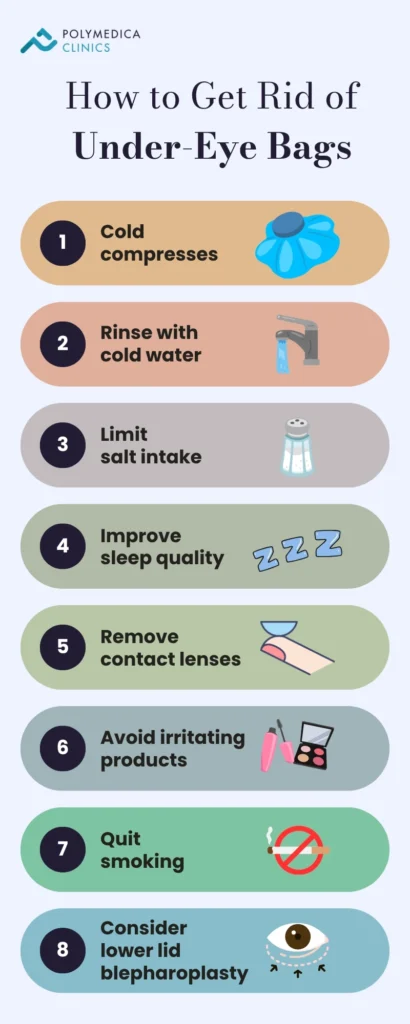
- Cold compresses. A cold, damp washcloth over closed eyes for a few minutes constricts blood vessels and reduces swelling. An ice pack or a bag of frozen vegetables wrapped in a towel works as well. Chilled cucumber slices, cooled tea bags, and cold spoons are common alternatives.
- Rinsing with cool water. Useful if there is any discharge, since it clears debris without adding irritation, and the cool temperature is soothing for allergy-related puffiness too.
- Limiting salt intake. Less sodium means less water retention overall, including around the eyes.
- Improving sleep. About seven to nine hours a night, with the head slightly elevated on an extra pillow, helps prevent fluid from settling around the eyes overnight.
- Removing contact lenses at the first sign of swelling. Continuing to wear contacts during eye swelling can make symptoms worse and prolong recovery, especially with conditions like pink eye.
- Avoiding irritating eye area products. Fragrances, dyes, and certain preservatives in eye makeup or eye creams can trigger irritation or an allergic reaction in some people. If a new product coincides with puffiness, stopping it for a couple of weeks is a reasonable check.
- Quitting smoking. Smoking accelerates collagen breakdown, thinning the skin around the eyes over time and making both puffiness and hollowing more noticeable.
A caution about hemorrhoid cream
Using hemorrhoid cream on the under-eye area is a trend that circulates periodically online, and it is not recommended by ophthalmologists. Most hemorrhoid creams contain hydrocortisone, a topical steroid, or phenylephrine, a vasoconstrictor. Around the eyes, hydrocortisone used repeatedly on this thin skin can cause skin thinning or discoloration, which can make dark circles worse rather than better, and it can irritate or injure the eye if any gets in. Phenylephrine can trigger allergic reactions and may interact with other medications. Both can cause a burning sensation. Any relief tends to be temporary, while the risks build with repeated use.
When Home Care Isn’t Enough
When puffiness persists despite lifestyle changes and home care, particularly when the cause is genetic fat prolapse or tear trough hollowing, an oculoplastic surgeon (an ophthalmologist who subspecializes in the eyelids and surrounding structures) can offer more targeted treatment in the form of a lower eyelid lift (blepharoplasty). This surgical procedure directly addresses fat prolapse and excess skin by removing or repositioning the herniated fat and tightening the eyelid. This is the definitive treatment for genetic or age-related eye bags that do not respond to nonsurgical options.
For dark circles caused mainly by skin pigmentation or thin, discolored skin rather than hollowing, treatments like laser skin resurfacing or chemical peels can help, and these are typically handled by a dermatologist.
In Summary
Most puffy eyes are simply fluid-related and clear up with rest, less salt, and a cold compress. Allergy-related puffiness needs allergy treatment rather than cosmetic fixes. Genetic, structural bags need an oculoplastic evaluation rather than home remedies, since they will not resolve on their own. And any swelling with eye pain, bulging, vision changes, or fever should be treated as urgent and seen by an ophthalmologist.
This article is for informational purposes only and does not constitute a diagnosis or treatment, nor does it substitute professional medical advice.